The island
Lord of the FliesThe island is the isolated tropical setting in which the stranded boys attempt to make a society, and the landscape that repeatedly tests and ultimately undoes that effort. At first it appears to offer freedom, food, and shelter; as the boys’ fear and rivalries deepen, its forest, mountain, and open shore become part of the danger. The same island that gives them a possible signal for rescue also becomes the means by which they are driven toward it.
Discovery and Geography
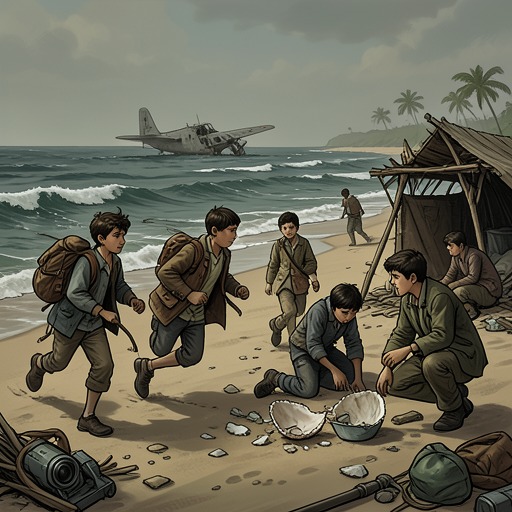
At their first meeting, Ralph and Piggy infer that they are on an island from the reef visible offshore. The boys have been separated in the crash, and the wreckage has been dragged out to sea; the possibility that other children remain in it makes the landscape feel both alluring and perilous. Their immediate problem is not simply where they are, but whether any adult knows where they are. Piggy recognizes that the atomic war has left no dependable chain of rescue, so isolation becomes the condition shaping every later decision.
The expedition to the summit turns that uncertainty into a shared view. From the mountain, the boys see a roughly boat-shaped landmass, with a steep descent on one side and a gentler, tree-covered slope toward the jungly flat and pink tail at the other. A separate rock, almost detached from the island and rising like a fort, faces them across the greenery; the reef lies roughly a mile offshore and encloses more than one side. Inside it, the water is clear enough to show rocks and weed, while the sea beyond is dark blue. The boys can also trace the scar left by the crash down toward the shore and locate The platform near The lagoon. These landmarks make the island legible to them, but the view does not reveal a route home.
The mountain offers height and perspective, not safety. From its summit the boys see no village smoke or boats and conclude that the island is uninhabited. The conclusion is based on what they can observe, and it makes their own conduct seem all the more consequential: with no visible adult settlement to appeal to, they must decide how to organize themselves. The island’s apparent ownership is exhilarating at first, but their claim to it is an expression of discovery, not control.
A Landscape to Live From—and Signal Through
The island provides food and material for immediate survival. Wild pigs are present in the forest, and Jack Merridew argues for hunters; the first expedition has already revealed a pig that escaped. The forest also supplies wood, while the boys use Piggy’s glasses to kindle a fire. Yet the landscape does not make these resources self-managing. A fire must be tended and made visible, and hunting requires coordinated effort. The island offers the means of survival only on terms that demand shared responsibility.
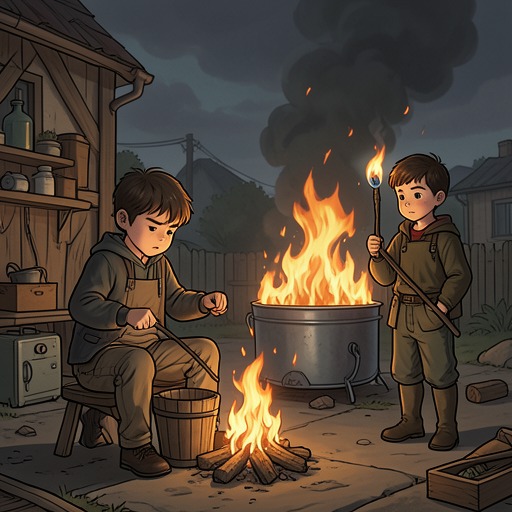
The signal fire gives the mountain a second meaning. Its height makes it a place from which smoke might be seen by a passing ship, and Ralph insists that a lookout and a maintained fire are essential to rescue. When the boys feed the blaze with wood, flame rises high above them, but the effort produces little smoke. They learn that a conspicuous fire is not necessarily an effective signal: green branches are needed to make more smoke, and someone must keep watch. The distinction between fire as spectacle and fire as a practical message becomes a test of whether the boys can sustain a common task.
That task depends on rules as much as on fuel. At the assembly on The platform, Ralph establishes that the conch gives its holder the right to speak without interruption. Jack Merridew urges the creation of rules, while Piggy explains why the absence of adults makes their decisions urgent. Later, on the mountain, Piggy tries to use the conch to claim a hearing, but Jack Merridew rejects its authority there. Ralph responds by saying the signal fire requires designated keepers and that the conch’s meeting rule applies on the mountain as well. The landscape has thus become a test case for the reach of their shared authority: a rule matters only if the boys agree to uphold it away from the place where it was first established.
From Shared Territory to Divided Ground
As fear of the beast grows, the island’s geography no longer supports a single common project. After seeing what they believe is the beast on the mountain, Ralph and Piggy return shaken; the mountain, previously a vantage point from which the island could be surveyed, now seems occupied by a threat overlooking the fire. Ralph doubts that they could fight a creature of that size and worries that it is squatting by the signal fire. His fear is practical as well as psychological: if the fire cannot be kept, the possibility of rescue seems to disappear.
Jack Merridew uses this fear to draw followers away from Ralph’s assembly and the conch. Near the end of the island, he tells the choir that they will forget the beast, hunt, and later go to Castle Rock. He also proposes leaving part of a kill for the beast in the hope that it will leave them alone. The plan turns the island’s animals and terrain into elements of a new political order: hunting promises food and collective excitement, while an offering attempts to manage a danger the boys cannot explain. The beach fire and the proposed move toward Castle Rock mark a widening separation from Ralph’s insistence on maintaining a signal and the procedures associated with The platform.
The island’s open spaces do not guarantee visibility or safety. Its forest can conceal a pursuer and interrupt escape; the mountain can become a place of terrifying misrecognition; the shore can gather the boys into a crowd. When the conch is shattered at Castle Rock and Piggy is killed, the island’s divided society has lost both the emblem of its speaking order and the boy who repeatedly argued for practical judgment. Ralph flees into the forest, where the hunters’ pursuit and the spreading fire leave him with fewer places to hide. The landscape that once appeared spacious enough for independent exploration has become a trap shaped by the boys’ own violence.
Fire, Rescue, and the Island’s Reversal
The final pursuit changes the function of fire once more. The flames race through the forest, setting a shelter alight and driving Ralph toward the beach. The fire is no longer a carefully maintained signal on the mountain or a limited means of making flame; it is a spreading force that transforms the island into an open emergency. The boys’ attempt to hunt Ralph and the burning vegetation converge at the shore, where he falls into the warm sand and finds a naval officer and a cutter with ratings.
The officer says that smoke brought them to the island. Rescue therefore comes through the same signal logic that Ralph had tried to preserve, but in catastrophic form: the immense fire that endangers the island has made the smoke visible. Behind the officer, the boys stand silent, their bodies marked with coloured clay and their sharp sticks still in hand; the burning reaches the coconut palms and consumes them noisily. The scene does not restore the island to its earlier appearance or erase what has happened. Instead, the shore becomes the point where the boys’ isolated world meets adult authority again.
The island’s significance lies in this reversal. Its natural features are not merely a backdrop: the reef establishes enclosure, the mountain offers both oversight and terror, the forest sustains hunting and conceals violence, and the beach becomes both the edge of isolation and the place of rescue. The signal fire binds those meanings together. What begins as a shared effort to be seen ends in a blaze that exposes the collapse of the boys’ common order even as it makes their rescue possible.